

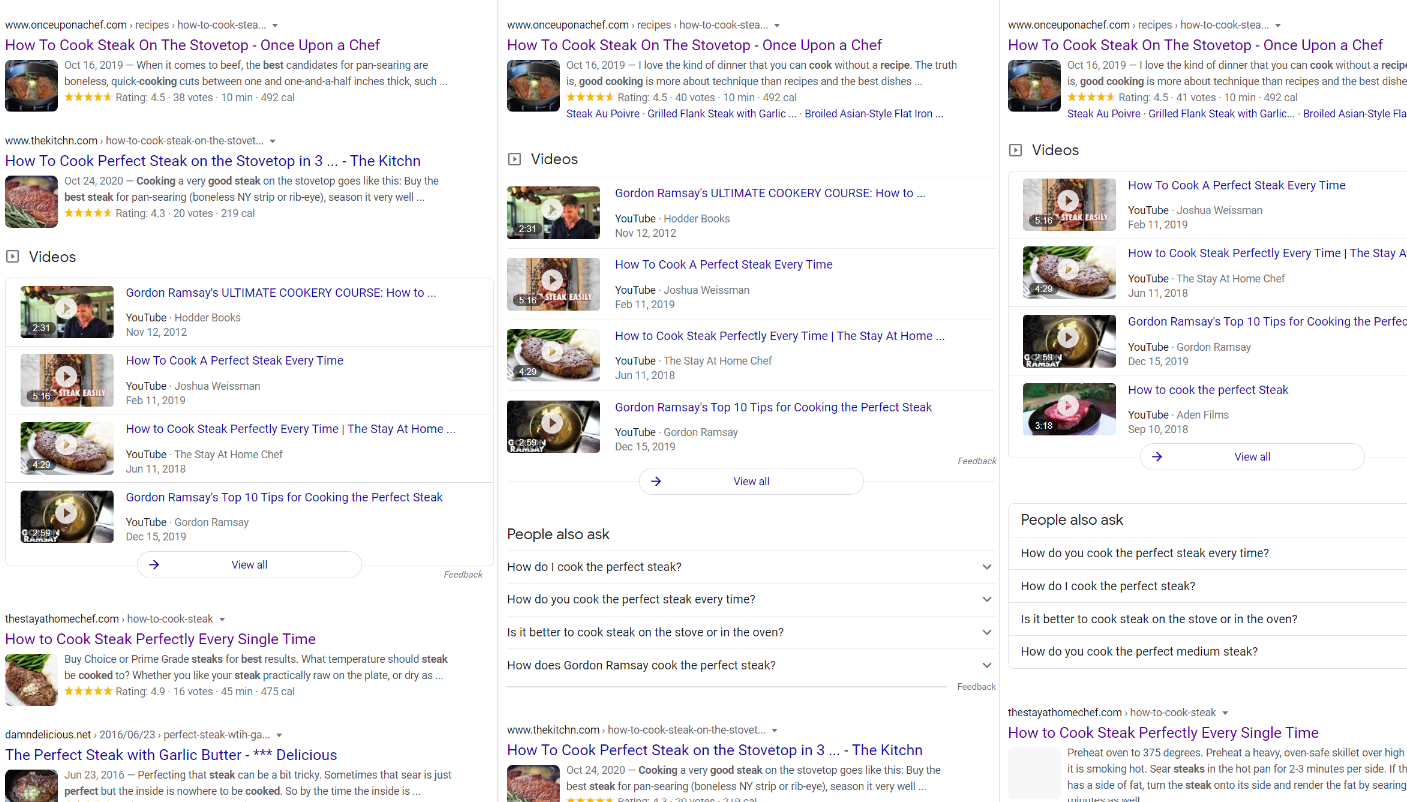
Google does not publicly reveal the “secret sauce” that drives their search algorithm, and the company is constantly changing and adjusting the results to constantly make the results cleaner and more efficient. But despite all this mystery and complexity, it is still possible to improve the performance of your site with a few relatively direct steps.
According to Kevin Miller, co-founder and CEO of Los Angeles-based digital marketing agency GR0, a big positive impact on these rankings can be as simple as setting up profiles on major social media sites and web directories. “Platforms like Glassdoor, BuiltIn and Clutch, to name a few, have incredibly strong domain rankings, allowing these profiles to rank high on Google searches,” Miller explained. “For most companies, if your profile is built properly, there is a very high chance of ranking on the first page of your brand name. This allows the brand to basically dominate the SERP (search engine results pages) pages in a short period of time. “
GR0 offers a custom B2B service with just one mission: to help brands rank No. 1 on Google. GR strives to demystify the SEO process for its clients, enabling them to reach their full potential and deliver unmatched value to every customer. Now, in collaboration with dot.LA/founder’s guide, they are sharing his secret sauce for the first time: 7 tips on how to win your brand SEO.
STEP 1: GETTING STARTED / BASIC TIPS
The first and most important step of all comes right at the top: creating a list of keywords and phrases, along with your brand name, that you most want to highlight in Google results. Keep in mind that the most popular and most searched words and phrases are extremely competitive, so it’s wise to choose some secondary or tertiary keywords as well. On the same subject : Avoid the 7 Easy But Tough SEO Tactics. (Instead of trying to rank for the term “dentist,” for example, try “West Philadelphia Dentist” or “West Philadelphia Painless Dentist” or “West Philadelphia Painless Cheap Dentist.”)
You’ll include these keywords in every item about your product or company or service that you post on other sites, so they should be relevant and natural for you to elaborate into sentences.

STEP 2: GLASSDOOR
Glassdoor is a large and very well-established service that allows technology employees to rate and review their employers. This may interest you : 10 Tips for Creating a Comprehensive SEO Strategy.
As with Comparably, there are a number of benefits to having an “employer profile” on Glassdoor. It’s a way to take control of the conversation and present your company and brand in the most positive and effective way possible, giving potential employees a clearer idea of what it’s like to work for you.

STEP 3: GOOGLE MY BUSINESS PAGE
My Business is a free Google tool that helps companies manage their online presence. This is a particularly important tool for local businesses looking to achieve greater exposure in their immediate region or primary area of operation, as Google organizes search results based on your location during search. On the same subject : Complete SEO Checklist for Web Owners. This means that a company with a clearly marked location will have a better performance in searching people in the area.
Google uses the date from the My Business pages to launch its Knowledge Graph, an important component in how the algorithm structures and organizes information. Also, Google creates a Maps location for each My Business listing, so your business will now appear in Google Maps searches and searches within any third-party platform using the Google Maps API.
STEP 4: CRUNCHBASE
Crunchbase collects basic information about startups and industry trends and contains profiles of individual companies. Because it is a long-standing and reliable resource that also allows business owners to customize and supplement their profiles, it is also a powerful SEO tool.
When you fill out your Crunchbase profile, the details are always better than vague generalities or “marketing speech”. Also, avoid using phrases like “my company” or “our company”. Whenever you can, without sacrificing readability, insert your brand name.
Fill out your entire profile without missing important steps. “Founding Date” is a popular search among Crunchbase users, so make sure you fill this out as well. Also, keep in mind that investors primarily use Crunchbase for funding research, so the more thorough you can be in those sections – including links to articles about your previous rounds, if available – the better. Also be sure to update your Crunchbase file when there is important news about your company.
STEP 5: BUILT-IN LA
This community for startups, technology companies and their employees has a local element: in addition to Los Angeles, there are built-in websites that serve Austin, Boston, Chicago, Colorado, New York, San Francisco, Seattle and more. The site is mostly structured around employee satisfaction and employment, but it’s also another quality link that points to your business, increasing your visibility among people who generally scan technology startups in LA.
STEP 6: COMPARABLY
Comparable is a community tool that allows employees to safely and anonymously review and discuss their employers. For employers, in addition to the SEO benefits of setting up a Comparably profile, having a favorable Comparably page with honest and accurate employee reviews can be a great way to attract additional talent.
Because it is comparably established in its vertical and contains original editorial content that keeps the site active and relevant, their pages appear high on Google for dozens of search terms related to jobs and job search. This helps not only in employment, but also in media visibility; these profiles are a great way to enhance employee-oriented employee benefits and programs, such as diversity and inclusion efforts.
STEP 7: CLUTCH
Clutch.co is also based on ratings and reviews, but from a B2B perspective, not from an employee and employer perspective. The Clutch platform provides detailed reviews of companies offering B2B services based on analytics and feedback from former clients, to see how companies and their services are compared in specific markets. These profiles have the same benefits as employee-focused services, but only for companies that want to attract the attention of other managers, founders and startups in the B2B space.
STEP 8: SOCIAL MEDIA
While the previous steps were based on setting up one-time profiles, some of which require occasional updates, it’s also important for your business to regularly post fresh content on major social media sites, including Twitter, LinkedIn and Facebook.
Social media posts don’t directly contribute to your SEO rankings, but the links shared on these platforms increase your company’s exposure and can ultimately help improve your rankings in a number of ways. Studies have repeatedly found a correlation between social sharing and SEO rankings for individual links.
It is a good practice to tweet at least once or twice a day and then post the same content on your company’s LinkedIn and Facebook profiles.
How do I add SEO to my website?
How to do SEO for a website
- Research keywords and use relevant terms. Keywords play an important role in SEO. …
- Place keywords on the entire page. …
- Include SEO in permanent links. …
- Hyperlink your existing content. …
- Write high quality content. …
- Optimize your images. …
- Page speed. …
- Don’t forget your mobile version!
What is SEO target?
The SEO process mainly targets organic links and search engine placement; however, it is often complemented by more aggressive measures (e.g. paid search ads) and is often part of traditional marketing campaigns.
How do I promote my website on Google?
Consider improving with Google AdWords With Google AdWords, you create an ad with a link to your website or landing page. For example, you can create an ad that promotes a specific product that leads to a landing page that describes the benefits of the item and provides a link to purchase.
How much does it cost to promote a website on Google?
How can I promote my website on Google for free?
Google My Business If you’re trying to promote your website to a local audience, be sure to set up a business profile on Google My Business. Register your data for free and make your business more accessible to potential customers looking for products and services in your niche, in your area.
Can I pay Google to promote my website?
Google ads give you control over your advertising budget. Set a monthly budget limit and never exceed it. In addition, you can pause or adjust your spending at any time.
Can you pay Google to improve your SEO?
The simple answer is no. Paying for ads on the Google search network can bring you to the top of the page, but that doesn’t improve your ranking in organic search. Google’s search rankings are determined by many factors, from website health and number of backlinks to geographic location.
Can I promote my website on Google Ads?
AdWords comes with a variety of customizable options for tracking and measuring your ad campaigns. You can set and track traffic goals on your website, return on investment, sales and conversions and more. You can also measure which keywords have the best performance, which title gets the most clicks, and so on.
How many keywords is too much?
Choose keywords that are relevant to the topic of each website. Each keyword should be strategically selected and placed. Keep in mind that you shouldn’t exceed 20 keywords per page, regardless of whether the ideal keyword density matches the amount of content.
Is it good to have a lot of keywords? There is great potential when targeting broad-matched keywords. For example, in the health and wellness industry, you’ll generate 94% more clicks if you target these broad-matched keywords. A broad-matched keyword also means that your ads will show no matter what a potential customer intends to do.
Are too many keywords bad for SEO?
In the past, keyword stuffing was a relatively successful SEO strategy. However, adding keywords to your content too many times today can actually destroy your content on the search rankings or even lead to the complete removal of your content from the search list.
Does Google penalize too many keywords?
You could also be penalized for using the same exact content from another site or using a keyword too many times on a page, known as a “full keyword.” Penalties are also due to constant changes in the rules. With rapid change, most SEO agencies cannot keep up with the latest improvements.
Are too many keywords bad?
There’s definitely no need to strain trying to reach the 30-keyword tag in each ad group; in fact, it’s okay to have an ad group with less than 30 keywords.
How many keywords should you have for SEO?
At least one; some pages may have a unique focus that responds to only one query. You’re much more likely to want to target two or three keywords per page, even if they’re just close variations. More than four is a bit crowded; after all, each page has only one title tag and meta description.
How many keywords are ideal?
You should focus on two to three keywords for each page as a minimum. This includes one main keyword and two closely related queries. If you can focus on more keywords while the content sounds natural, try optimizing it for more variations of SEO keywords.
How many keywords should you track?
Tracking 1-2 keywords per page can be a good start. Second, finding competitors’ keywords helps. Most clients want to beat their competitors for the keywords by which they rank. It is therefore recommended that you optimize and track competitors’ keywords that have a high search volume.
How many keywords should a company have?
For most small businesses, it is recommended to target around 5 keywords (each with a monthly search volume of 100). For some companies, this may not seem like much, but targeting 5 keywords does not mean that your website will only rank for 5 keywords and get 5 keyword traffic.
Does Google penalize too many keywords?
You could also be penalized for using the same exact content from another site or using a keyword too many times on a page, known as a “full keyword.” Penalties are also due to constant changes in the rules. With rapid change, most SEO agencies cannot keep up with the latest improvements.
Is SEO hard to learn?
SEO just isn’t as difficult as people pretend it is; you can get 95% effort with 5% of the work, and you absolutely don’t have to hire a professional SEO to do it, nor will it be difficult to start ranking for well-chosen key terms.
How long does it take to learn about SEO? It takes 1-3 months to learn the basics of SEO. The basics of search engine optimization can be understood and learned within 3 months, however, more advanced concepts can take 6 to 18 months. This is provided that you consume knowledge on a daily basis and learn from experts.
Is Google SEO difficult to learn?
SEO is not that hard to learn. All you need to do is be willing to take the time and effort to learn different SEO concepts. If you are just starting out with SEO and are wondering what it takes to become an expert from a beginner, then this post is for you.
Why is SEO so difficult?
In short, SEO is difficult because search engines are always changing and updating. It could be anything from Google changing the way they look at a particular type of connection, including a new major update to their algorithm or even recognizing something new as a ranking factor.
Is Google SEO worth learning?
The short answer is SEO is very effective – not only for generating traffic, but also for potential customers and sales. Do not worry. A long answer involves research and data, not just empty statements. Most SEOs are too preoccupied with search-specific metrics such as SERP (search engine results page), rankings, and organic traffic.
How long does it take to learn Google SEO?
It may take you 4-6 weeks to 5-8 years to learn SEO, depending on factors such as the level you want to achieve, the amount of time you are willing to spend learning SEO, your current experience, how persistent you are, what resources you use and more.
How hard is to do SEO yourself?
You can absolutely do SEO or DIY SEO (Do It Yourself SEO). With some research and a lot of practice, anyone can learn how to do SEO for their business. A quick way to get started with SEO is to enter your URL here and then focus your SEO efforts on recommended actions.
Is SEO good for beginners?
We have tried to make it as concise and easy to understand as possible, and learning the basics of SEO is a crucial first step in achieving the goals of your online business.
Is it hard to do your own SEO?
You can absolutely do SEO yourself. With some research and a lot of practice, anyone can learn how to do SEO for their business. A quick way to get started with SEO is to enter your URL here and then focus your SEO efforts on recommended actions.
Can one person do SEO?
Some companies are so heavy that SEO teams can easily have one person dedicated to reporting and estimating revenue growth / decline based on proposed changes.

Comments are closed.